
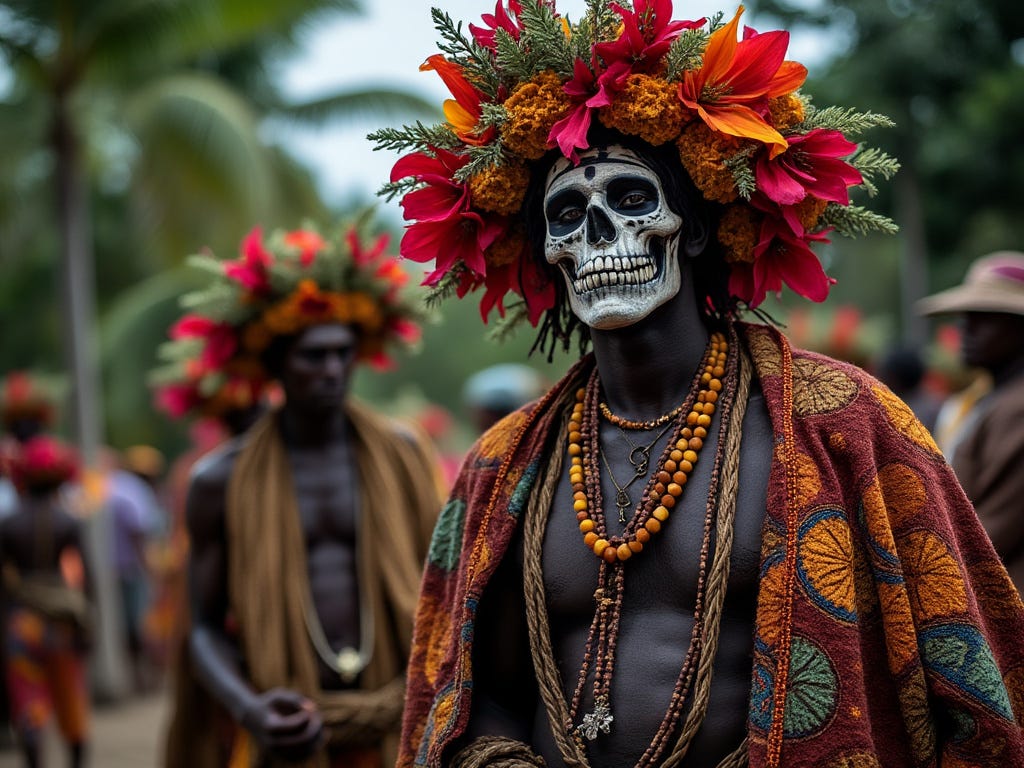
Voodoo, Voudon, Hoodoo
Start with the word: Voodoo, an anglicized version of Vodun is Fon and Ewe, languages spoken in what is now Benin and Togo, and it means roughly “spirit” or “divine being.” Voodoo and Vodun (or Voudon) are basically alternate spellings of the same religion. Everything downstream — Haitian Vodou, New Orleans Voodoo — carries that word across the Atlantic in the holds of slave ships. Hoodoo, coined by Zora Neal Hurston, is the word for the unique practice of New Orleans voodoo.
Essentially, three African streams feed the tradition. From the Fon and Ewe of Dahomey came the vodun themselves and the ritual architecture built around them. From the Yoruba, further east, came the orisha and sophisticated systems of divination. From Kongo, in Central Africa, came ancestor practice, ideas about the boundary between the living and the dead, and the minkisi — consecrated objects charged with spiritual power, direct ancestors of what Louisiana would call gris-gris.
These systems share a basic shape. A creator god exists but is remote and not directly petitioned. Between that god and humanity stands a crowded population of spirits, each with a personality, preferences, colors, foods, and songs. You approach them through offering, drumming, and dance, and under the right conditions a spirit mounts a devotee and speaks through them. The dead remain present and owed attention. This is a complete religion — cosmology, ethics, initiation, priesthood — and not, whatever three centuries of European-based writing insisted, a species of witchcraft.
Zora Neal Hurston, an African American writer and anthropologist, introduced the religion to a broader American audience in her book, Tell My Horse (1938), an ethnographic study that covers Haiti and Jamaica. Neal received support from Guggenheim Foundation to do fieldwork in those island nations during 1936–37. The title comes from the possession idiom: the lwa (the spirit) mounts a devotee, who becomes the spirit’s horse, and Papa Guédé speaks through them prefacing his remarks with “tell my horse.” The book includes her photograph of Felicia Felix-Mentor, a woman at a hospital in Gonaïves said to have died decades earlier, which makes it the first published photo of a purported zombie, and the image that did much to launch the Zombie sub-genre. During her field work in Haiti, Hurston also wrote her most famous novel, Their Eyes Were Watching God, in the span of about seven weeks. Putting most novelists to shame.
Two things distinguish Hurston from everyone else writing on this in her era. She insisted on Hoodoo as the American practitioners’ own word and treated the thing as a religion with an internal logic rather than as superstition to be catalogued. And she participated in rituals herself: she was initiated, repeatedly, rather than observing from outside.
She observed the Atlantic slave trade concentrated captives from the Bight of Benin and from Kongo into the French Caribbean, above all Saint-Domingue. There the Code Noir mandated Catholic baptism and forbade African worship, so practice went underground and acquired Catholic twists: saints standing in for the lwa, holy water, candles, novenas. Although some of that amounted to camouflage, much of it was sincere synthesis, and remains so today.
Louisiana’s own African population arrived in phases — heavily Senegambian during the early French period, with substantial Kongo influence after — but the decisive event was the Haitian Revolution. Between 1809 and 1810, roughly ten thousand refugees from Saint-Domingue, expelled from Cuba, landed in New Orleans. The city’s population nearly doubled, and its Afro-Creole culture was reinforced at precisely the moment American rule arrived to threaten it. Vodou came with them. This is when the Secte Rouge appeared on the scene. An anti-colonialist vigilante group dedicated to expelling European colonizers from Haiti through violence and intimidation. It’s unclear whether claims of cannibalism and human sacrifice were real, or merely folk tales designed to frighten.
What grew in New Orleans took a different shape from Haiti’s. Sunday gatherings at Congo Square, where enslaved and free Black people were permitted to drum, dance, and trade, sustained a public African ritual life that existed almost nowhere else in the United States. But New Orleans Voodoo organized itself around individual practitioners — queens, doctors, root workers — rather than around temples and congregations, and it leaned toward healing, protection, charms, and case-by-case problem-solving. Running alongside it was Hoodoo, which spread across the wider Black South: a body of folk magical practice rather than a religion, and a genuinely distinct thing.
The Voodoo doll, featured in my novel, comes from this Hoodoo tradition and owes its widespread fame to Hurston probably more than any other writer or anthropologist.