
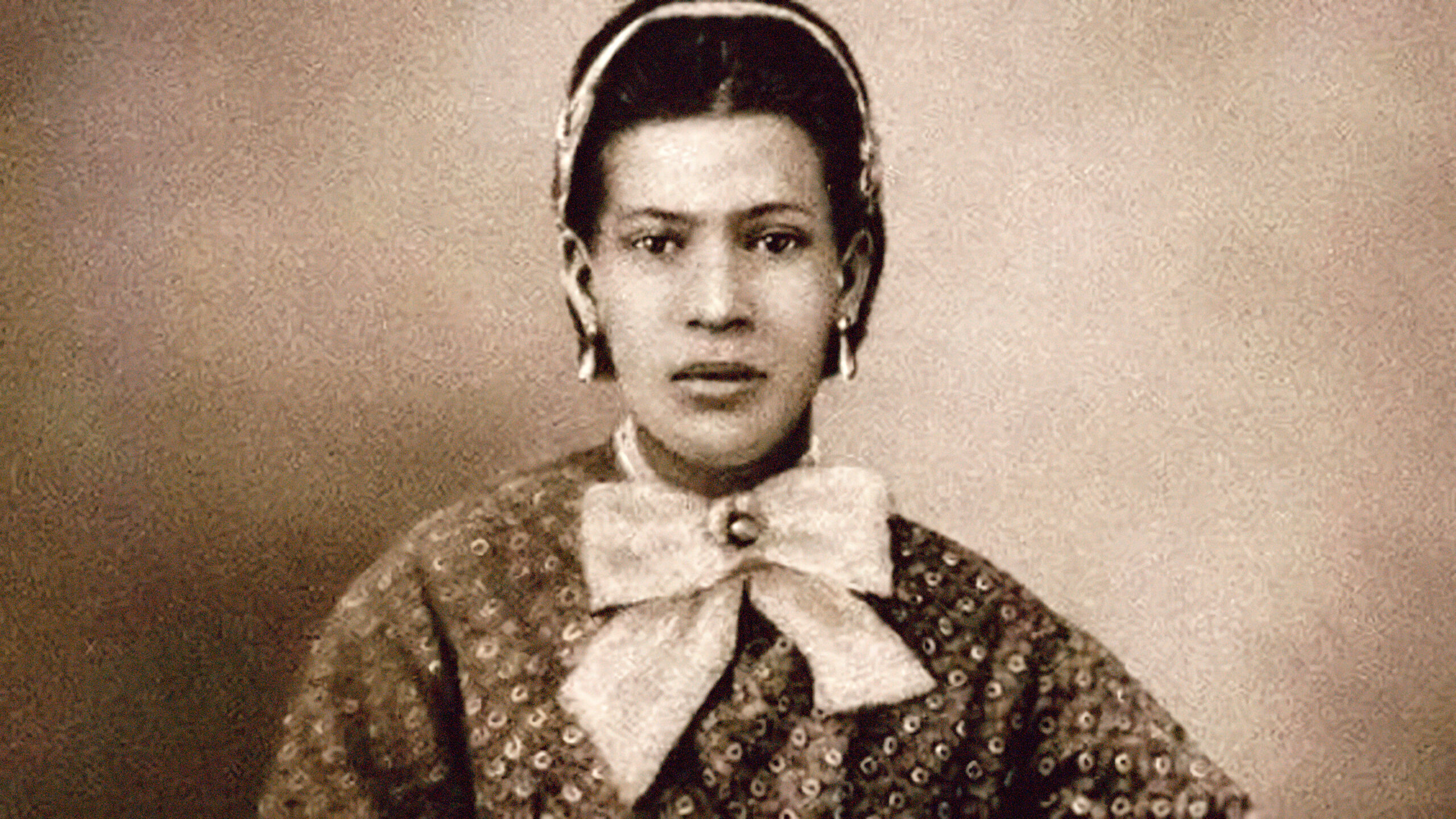
The Woman Behind the Voodoo Queen
There is a tomb in St. Louis Cemetery No. 1 in New Orleans that, for decades, was the second-most-visited grave in the United States. Only Elvis drew a bigger crowd. Pilgrims came with rum and coins and flowers, scratched three X’s into the plaster, turned around three times, knocked, and made a wish.
The woman interred there might have been horrified by the antics of these so-called pilgrims. After all, she spent her life as a devout Catholic. She attended Mass at St. Louis Cathedral, had her children baptized there, and was buried by a priest. Her obituary in the Daily Picayune described her a charitable, genteel woman who nursed the sick and comforted the condemned.
Yet, she is also known as the New Orleans Voodoo Queen. Souvenir shops sell voodoo dolls and mojo bags and trinkets associated with dark magic–all in her name.
Both of these things are true about Marie Laveau, and the space between them is where almost everything interesting about her lives.
A Free Woman of Color in a Segregated Society
Marie Catherine Laveau was born in New Orleans around 1801, in the last years before the Louisiana Purchase handed the city to the United States. Her father, Charles Laveau, was a free man of color and a man of some property. Her mother, Marguerite Darcantel, was also a woman of color. Marie was born free — a fact that shaped every single breath she took.
Antebellum New Orleans held a social category that barely existed elsewhere in the American South: the gens de couleur libres, free people of color. Under the French and Spanish legal traditions the city inherited, they could own property, sign contracts, sue in court, run businesses, and pass wealth to their children. They occupied a genuine middle tier in a society that everywhere else in the region insisted on only two. It was a precarious position, and it eroded steadily as American law tightened its grip through the 1800s. But in Marie Laveau’s lifetime, it gave a Black woman room to become something.
In 1819 she married Jacques Paris, a free man of color who had fled Saint-Domingue during the Haitian Revolution. The wedding occurred at St. Louis Cathedral. Within a few years Paris had vanished from the records entirely — died, moved to greener pastures, no one is certain — and Marie was known around the French Quarter as the Widow Paris, a name that stuck to her for the rest of her life and is carved on the tomb where she was eventually laid.
She then entered a long domestic partnership with Christophe Glapion, a white man of noble French descent. Louisiana law would not let them marry because of Laveau’s race. But they stayed together for roughly thirty years and raised a large family; oral tradition claims fifteen children, though the historian Carolyn Morrow Long, working through baptismal and burial records, could only confirm seven. Yellow fever and cholera took most of them young. That was ordinary in nineteenth-century New Orleans, which is its own kind of horror.
Only My Hairdresser Knows: Gossip Queen
The one salient detail that explains more about Marie Laveau’s reputation than any story about snakes or midnight rituals is that she was a hairdresser.
She dressed the hair of wealthy white women in their homes. She was in their bedrooms, hours at a time, week after week, for years. And women talk to their hairdressers. She would have known who was in debt, whose marriage was failing, which merchant had a mistress on Rampart Street, which son was gambling away the family money, who was pregnant and by whom.
When a client came to her later, frightened and desperate, asking for help with a husband or a lawsuit or a rival — Marie Laveau already knew the whole situation. She had known for months. To a client, that looks exactly like supernatural insight. It was, in a sense, the finest intelligence network in the city, and it ran on gossip and haircuts.
This doesn’t debunk her. It explains how a Black woman in a slave society accumulated real influence over powerful white households, and it makes her considerably more impressive rather than less.
Catholic and Voodoo: Wrap a Rosary Around Your Wrist & Carry a Gris-gris.
The burning question for many is whether Laveau “really” practiced Voodoo and used Catholicism as camouflage or whether she was “really” a Catholic who used voodoo as a means of asserting herself in a world that sought only to oppress her. The question misunderstands the world she lived in.
New Orleans Voodoo grew out of West African spiritual traditions — largely Fon and Yoruba, carried through the slave trade and reinforced by refugees arriving from Haiti after 1791 — and it developed in constant contact with Catholicism. Saints and spirits overlapped. Holy water, candles, incense, and novenas sat alongside herbal medicine, ancestor veneration, and drumming. For practitioners, these were not competing systems requiring a choice. They were one practice.
Laveau reportedly led public ceremonies at Bayou St. John, particularly on St. John’s Eve in late June, and was associated with the Sunday gatherings in Congo Square where enslaved and free Black people danced and drummed and traded. She also kept altars, sold charms and gris-gris, and gave what we would now call counseling — much of her work was closer to a combination of pharmacist, physician, therapist, and lawyer than to anything a horror movie would recognize.
And she did serious charitable work. She nursed victims during yellow fever epidemics when the wealthy fled the city and the poor died in the streets. She visited condemned prisoners in the parish prison, built altars in their cells, and sat with men in their last hours. This is the Marie Laveau her obituary described, and there is no reason to think it was invented.
The Woman Who Would Never Die
One of the more persistent legends holds that Marie Laveau remained young for decades. Observers in the 1870s described a woman who looked much as she had in the 1830s. Was it hair dye, proper exercise, and a good skin care routine, or something sinister?
The likeliest explanation is her look-alike daughter. Marie Euchariste Eloise Laveau, born in 1827, appears to have taken up her mother’s practice and her mother’s name. Two women, one reputation, forty years of overlap. The “immortal” Voodoo Queen was probably a mother and daughter working the same trade, and possibly a deliberate strategy rather than a public misunderstanding.
Unhappy Truths
An honest recounting of history requires not glossing over the uncomfortable parts. Records indicate that Laveau’s household at times included enslaved people, which was not unusual among propertied free people of color in New Orleans but sits badly against the popular image of her as a straightforward figure of Black liberation. She was a person operating inside a brutal system, not standing outside it.
It’s also worth knowing where the popular image came from. Much of it traces to Robert Tallant’s 1946 book Voodoo in New Orleans, which drew on Depression-era WPA interviews but sensationalized freely and treated its subject with open contempt. Tallant’s version — lurid, sexualized, faintly ridiculous — became the template for nearly everything written afterward, including a great deal of what tour guides still say on Bourbon Street.
While not as popularly known, serious scholarship on Laveau exists. Carolyn Morrow Long’s A New Orleans Voudou Priestess: The Legend and Reality of Marie Laveau (2006) and Ina Johanna Fandrich’s The Mysterious Voodoo Queen, Marie Laveaux (2005) both combed through sacramental registers, notarial acts, and court records to create a more accurate portrait of the legendary voodoo queen of New Orleans.
The Tomb
Marie Laveau died on June 15, 1881, at home on St. Ann Street, in her eighties. She was buried in the Glapion family tomb in St. Louis Cemetery No. 1.
At some point, no one is really sure when, legends grew up around her tomb and visitors started marking it with a series of three X’s. There’s no evidence it emerged in the years following her death. To the contrary, it looks like a twentieth-century invention that spread through tourism and then metastasized. What it produced was severe, ongoing damage to a fragile plaster-over-brick tomb that preservationists had to repair again and again.
Finally, on March 1, 2015, the Archdiocese closed the cemetery to everyone except descendants of those buried there and visitors accompanied by a licensed tour guide. That remains the case. If you want to see the tomb, you book a tour — and you leave the plaster alone!
Immortal Marie
Marie Laveau is now remembered as a voodoo priestess, which is probably the least interesting thing about her. What she actually was is far more intriguing: a free Black woman who built genuine power in a slave society, out of the materials available to her: her faith, her clients’ secrets, her herbs and charms, her nerve, and a talent for making herself indispensable to people who held every legal advantage over her. She fed the sick, sat with the dying, raised children in a city that kept killing them, and made herself the most famous woman in New Orleans.
She didn’t need voodoo for any of that.
Further reading
These resources proved helpful in my research:
- Carolyn Morrow Long, A New Orleans Voudou Priestess: The Legend and Reality of Marie Laveau (2006)
- Ina Johanna Fandrich, The Mysterious Voodoo Queen, Marie Laveaux (2005)
- Robert Tallant, Voodoo in New Orleans (1946) — read critically, as a document of how the myth was built rather than a reliable account